Your Credit History Explained

What’s my credit history?

Your credit history describes how you use money. It shows things like:

  • how many loans and credit cards you have
  • how much money you owe
  • how long you’ve had credit
  • if you pay your bills on time

The three nationwide credit bureaus — Equifax, Experian, and TransUnion — collect this information and put it in your credit report.

Read Checking Your Credit Report to learn how to order your report for free.

Why is my credit history important?

Your credit history tells businesses how you handle money and pay your bills. Your credit history can affect whether you get a job, can rent an apartment, or get a credit card or loan. It also affects how much you’ll have to pay in interest to borrow money.

Positive information helps your credit. Positive information includes things like paying your bills on time and having low credit card balances. Negative information, like paying bills late, hurts your credit.

What if I don’t have a credit history?

You might not have a credit history if:

  • you’ve never had a credit card
  • you’ve never gotten a loan from a bank or credit union

Without a credit history, it can be harder to get a job, an apartment, or even a credit card.

What’s a credit score?

A credit score is a number that’s based on your credit history. Each nationwide credit bureau creates a different score. Your credit score will usually range between 300 and 850.

It costs money to find out your credit score. Sometimes a company might say the score is free. But you might find that you signed up for a service that checks your credit for you. Those services charge you every month. Some credit card companies, such as Discover Card, provide free credit score with your monthly statement.  

Before you pay any money, ask yourself if you need to see your credit score. You might not since if you know your credit history is good, your score will be good.

For more information, go to:

Your Credit History Explained | consumer.gov

Teaching Suggestions

  • Ask students if they have a credit history.  If so, have they checked what information does it contain?
  • What actions can be taken to build your credit history?

Discussion Questions

  1. What is credit history?  What does if describe?
  2. Why is it important to know about your credit history?
  3. What might be the consequences if you don’t have a credit history?
  4. What can you do to build and maintain your credit rating?

10 Ways to Protect Your Personal Information

Identity theft affects millions of people each year and can cause serious harm. Protect yourself by securing your personal information, understanding the threat of identity theft, and exercising caution.

Here are 10 things you can start doing now to protect yourself and your loved ones from identity theft: 

  1. Protect your Social Security number by keeping your Social Security card in a safe place at home.
  2. Be careful when you speak with unknown callers.
  3. Create strong, unique passwords so others can’t easily access your accounts.
  4. Never give your personal or financial information in response to an unsolicited call or message, and never post it on social media.
  5. Shred paper documents that contain personal information, like your name, birth date, and Social Security number.
  6. Protect your mobile device from unauthorized access by securing it with a PIN, adding a fingerprinting feature, or using facial recognition.
  7. Regularly check your financial accounts for suspicious transactions.
  8. Avoid internet threats by installing and maintaining strong anti-virus software on all your devices—including your mobile device and personal computer. Use a virtual private network (VPN) to stay safe on public Wi-Fi.
  9. Protect yourself on social media by customizing your security settings and deleting accounts you no longer use.
  10. Never click on any link sent via unsolicited email or text message—type in the web address yourself. Only provide information on secure websites.

The Social Security Administration encourages you to create your own personal my Social Security account to track your earnings record. For more information, read Social Security Administration (SSA} publication, Protecting Personal Information. Contact SSA if you see suspicious work activity on your record–you could be a victim of identity theft.

For more information, click here.

Teaching Suggestions

  • Ask students if they, their friends, or relatives have been a victim of an identity theft? If so, what was their experience?
  • How often do you check your credit reports and why should you check your credit reports at least once a year?

Discussion Questions

  1. What actions have you taken to protect your personal information from being stolen by scanners?
  2. Why is it not advisable to carry your Social Security card in your wallet or your purse?

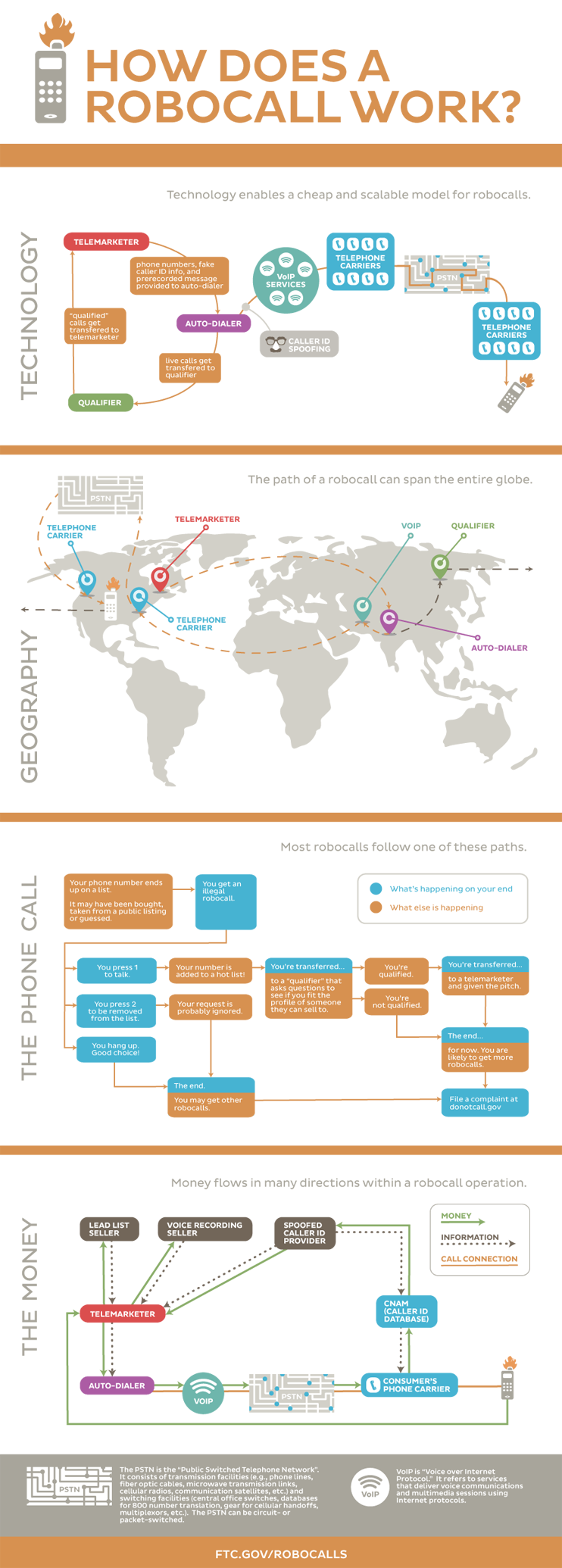
What is a Robocall?

If you answer the phone and hear a recorded message instead of a live person, it’s a robocall.  Americans have seen a significant increase in the number of illegal robocalls because internet-powered phone systems have made it cheap and easy for scammers to make illegal calls from anywhere in the world, and to hide from law enforcement by displaying fake caller ID information.

To date, the Federal Trade Commission (FTC ) has brought more than a hundred lawsuits against more than 600 companies and individuals responsible for billions of illegal robocalls and other Do Not Call violations.

The FTC also is leading several initiatives to develop technology-based solutions. Those initiatives include a series of robocall contests that challenge tech gurus to design tools that block robocalls and help investigators track down and stop robocallers. The FTC also is encouraging industry efforts to combat caller ID spoofing. Here’s the FTC’s game plan to combat robocalls:

  • continue aggressive law enforcement
  • build better tools for investigating robocalls 
  • coordinate with law enforcement, industry, and other stakeholders
  • stimulate and pursue technological solutions.

For More Information, click here.

Teaching Suggestions

  • Ask students how they or their families respond to robocalls.  Has the number of robocalls increased in recent months?  If so, what might be the reasons?
  • Ask students to make a list of actions to take in combating robocalls.  Share the list with other students.

Discussion Questions

  1. Should you consider reducing unwanted sales calls by submitting your phone numbers to the National Do Not Call Registry?
  2. Why doesn’t the National Do Not Call Registry stop robocalls?
  3. Are robocalls legal?  What kinds of robocalls are allowed without your permission?
  4. How can you manage to get fewer robocalls?

Better Credit by “Piggybacking”?

Is it possible for a person with bad credit to inflate his/her own credit score and get the money-saving benefits of better credit by “piggybacking” on the credit of a stranger? That’s how a Denver-based business pitched its services to cash-strapped consumers. But the Federal Trade Commission says the defendants couldn’t back up their score improvement claims and engaged in several illegal practices that violated the FTC Act, the Credit Repair Organizations Act (CROA), and the Telemarketing Sales Rule.

BoostMyScore and CEO William O. Airy claimed to offer consumers “the amazing benefit” of having another person’s credit “‘copied and pasted’ on to your credit report,” giving the buyer “the biggest possible FICO® score boost in less than 60 days; and it’s guaranteed!” Here’s how the defendants described their services, for which they charged consumers between $325 to $4,000 – or even more:

Online and in radio ads, the defendants promised consumers concrete benefits – for example, qualifying for a mortgage. According to one promotional piece, “ . . . many of our customers realize a jump of about 120 points in as little as two weeks. What would a credit score increase of that size mean for you? If you are like most people, that could be the difference between having your mortgage application approved or not.”

The settlement prohibits the defendants from marketing credit repair services that attempt to add an authorized user to anyone’s credit unless that person has actual access. In addition to other provisions to protect consumers in the future, the proposed order prohibits misrepresentations about the legality of credit piggybacking. Most of the proposed $6.6 million judgment would be suspended due to the defendants’ financial condition.

For More Information click here.

Teaching Suggestions

  • Ask students if it is possible to boost their own credit scores by someone else’s good credit.
  • Ask students if they know what information creditors use in determining whether a loan will be approved or denied.

Discussion Questions

  1. What can be done to prevent companies such as Boost My Score, to stop deceiving already financially-strapped consumers?
  2. How effective are the cease-and-desist orders and fines by the Federal Trade Commission, if the defendants don’t have to pay due to their financial condition?
  3. What are the true and tried methods of improving your credit scores?

Apartment Loans

Many recent college graduates choose to rent expensive, upscale apartments rather than putting money into savings. Their “fear of missing out” (FOMO) on being “close to the action” or luxury-living amenities comes at a cost, with high demand for these units resulting in spiraling monthly rents.  To cover these higher costs, “apartment loans” are now available in several urban areas.

Similar to the high-risk mortgages that triggered the financial crisis in 2008, apartment loans may be viewed as predatory lending.  Renters may borrow up to $15,000 with no interest for the first six months, but then encounter an annual interest rate of 15-17 percent.  Some justify these loans in that the costs are lower than payday lending.

If you have to take out a loan to pay the rent for an apartment…you CAN’T afford to live there.  Your ability to build wealth and long-term financial security will depend on living within your income.

For additional information on apartment loans, click here.

Teaching Suggestions

  • Have students conduct a survey of renters to determine actions they took to determine the location and cost of obtaining an apartment.
  • Have students create a visual presentation with the dangers of apartment loans.

Discussion Questions 

  1. What actions might be considered to avoid apartment loans?
  2. Describe financial and personal concerns associated with apartment loans.

Avoid Tax Refund Advances

Each year, more than 1.5 million taxpayers obtain refund anticipation loans (RALs).  This year, the number may be higher as a result of the government shutdown.  While, RALs provide faster access to your money, they come with high fees and should only be used as a last resort.  These “cash advances” are a potential for scams; before using these loans, take these actions:

  • Assess the cost. While some national tax chains promote this service as a “free” cash advance, fees may apply for applying for the advance, checking your credit, and transferring the money to you. Costs for your refund advance check range from $29 to $65.  If your refund is on a prepaid debit card, there will likely be additional fees.
  • Beware of loan terms based on timing. Additional charges may occur if your refund is delayed.
  • Compare other options. Seek less expensive, small-dollar, short-term loans from a community bank or credit union, or a zero-percent credit card. A $35 charge to defer a $350 tax preparation fee for two weeks has an APR of 174 percent.
  • To avoid late fees for bills, contact your creditors. Utility companies and medical providers may offer no-cost extensions or no-cost payment plans.

Always be sure you are doing business with a reputable tax preparer. Check credentials and references. Avoid tax preparers who charge fees based your refund amount, or who deposit your refund in their bank account. Another fraudulent activity is filing false information to increase the amount of the refund.

For additional information on tax refund advances, click here.

Teaching Suggestions

  • Have students search online for costs for refund anticipation loans.
  • Have students prepare a video presentation on avoiding refund anticipation loans.

Discussion Questions 

  1. What advice would you give a person planning to obtain a refund anticipation loan?
  2. How might community organizations and government agencies assist people who are considering a refund anticipation loan?

Common Credit Report Errors

What are common credit report errors that you should look for on your credit report?  When reviewing your credit report, check that it contains items about you.  Be sure to look for information that is inaccurate or incomplete.

Some common errors in credit reports are:

Identity errors

  • Errors made to your identity information (wrong name, phone number, address)
  • Accounts belonging to another person with the same name or similar name as yours (this mixing of two consumer’s information in a single file is called mixed file)
  • Incorrect accounts resulting from Identity theft

Incorrect reporting of account status

  • Closed accounts reported as open
  • You are reported as the owner of the account, when you are actually just an authorized user
  • Accounts that are incorrectly reported as late or delinquent
  • Incorrect date of last payment, date opened, or date of first delinquency
  • Same debt listed more than once (possibly with different names)

Data management errors

  • Reinsertion of incorrect information after it was corrected
  • Accounts that appear multiple times with different creditors listed (especially in the case of delinquent accounts or accounts in collection)

Balance Errors

  • Accounts with an incorrect current balance
  • Accounts with an incorrect credit limit

For more information, click here.

Teaching Suggestions

  • Why is important to check your credit reports every year?
  • Credit bureaus are required to follow reasonable procedures to ensure that your credit report is accurate, then why mistakes may occur?
  • Ask students if they have ever been contacted a credit bureau to dispute the accuracy of its information. What was the outcome?

Discussion Questions

  1. When you notify the credit bureau that you dispute the accuracy of its information, what must the credit bureau do to rectify mistakes?
  2. What are your legal remedies if a consumer reporting agency fails to comply with the provisions of the Fair Credit Reporting Act?

Cash or Credit?

“Currency still has its place, despite the pervasive use of plastic.”

Today, it seems that more people are using credit or debit cards to pay for everything.  And yet, this article provides reasons why cash may be a better payment option.  Those include

  1. A cashless society? Not so fast.  According to a recent Federal Reserve Bank of San Francisco study, 40 percent of consumer transactions involve cash–a higher percentage than for debit cards (25%), credit cards (17%), electronic payments (7%), and checks (7%).
  2. Currency comes in handy. Most vending machines don’t take plastic, and cash works best for all small purchases.
  3. Hamiltons can’t get hacked. With data breaches of major retailers becoming common, some consumers pay by cash to protect their credit card information.
  4. A cash fix can cost you. If you get a cash advance from an ATM outside your bank’s network, you’ll pay more than $4, on average.
  5. Cash is a great budgeting tool. If you have trouble controlling your spending when you pay with credit cards, then cash or a debit card is best for your finances.
  6. Paying by cash may be a good option, but it won’t help build your credit history. Using a credit card now and then for routine purchases can help build a good credit history.

For more information, click here.

Teaching Suggestions

You may want to use the information in this blog post and the original article to

  • Reinforce the concept of paying by cash.
  • Discuss what happens when people use their credit cards and overspend.

Discussion Questions

  1. Would you prefer to pay for merchandise and services with cash or credit? Explain your answer.
  2. How could paying with cash help you balance your budget and control spending?

The Credit Repair Organizations Act

The Credit Repair Organization Act (CROA) makes it illegal for credit repair companies to lie about what they can do for you, and to charge you before they’ve performed their services.  The CROA is enforced by the Federal Trade Commission and requires credit repair companies to explain:

  • your legal rights in a written contract that also details the services they’ll perform,
  • your three day right to cancel without with any charge,
  • how long will it take to get results,
  • the total cost you will pay, and
  • any guarantees.

What if a credit repair company you hired doesn’t live up to its promises?  You have some options.  You can:

  • sue them in federal court for your actual losses or for what you paid them, whichever is more,
  • seek punitive damages—money to punish the company for violating the law,
  • join other people in a class action lawsuit against the company, and if you win, the company has to pay your attorney’s fees.

For more information, click here.

Teaching Suggestions

  • Ask students to make a list of major provisions of the Credit Repair Organization Act.
  • Ask students if there is a time limit on reporting negative information about criminal convictions.

Discussion Questions

  1. Where and how can you report credit repair frauds?
  2. Can the FTC resolve individual credit disputes? If not, why should you file the complaint with the FTC?

Auto Dealer Financing

You want a car and need financing, but your credit isn’t so great.  Most dealerships have a Finance and Insurance (F&I) Department that will tell you about their financing options.  To get the process started, the F&I Department will ask you to complete a credit application, which includes your monthly income and information on current credit accounts, including debt you owe.

At least that is how it’s supposed to work.  But there have been reports that some dealers inflate your income information for the financing without your knowledge.  That can cause you serious financial harm.  You could be saddled with car financing that you can’t afford to repay.  That means your car could be repossessed and your credit score could take a hit.

The Federal Trade Commission has a few tips to help you avoid unscrupulous finance deals:

  • Consider your options for financing. You might be able to arrange financing directly with a credit union or finance company before you pick a car.
  • Research the dealer before visiting the sales lot. Check the dealer’s reputation online by searching for the company’s name with words like “scam,” “rip-off,”or “complaint.”
  • If a dealer encourages you to overstate your income, take it as a sign that the dealer is not reputable, and leave the dealership.
  • Ask to see the credit application, completely filled out, before you sign it. Make sure your income and other personal information is correctly listed.

For more information, click here.

Discussion Questions

  1. Why is it important to consider other sources of financing before visiting an auto dealer?
  2. What might be the consequences if an auto dealer inflates your income?

Teaching Suggestions

  1. Have students visit an auto dealership to gain additional insight into this high-cost financing service.
  2. Have students make a short presentation with a summary of their findings.