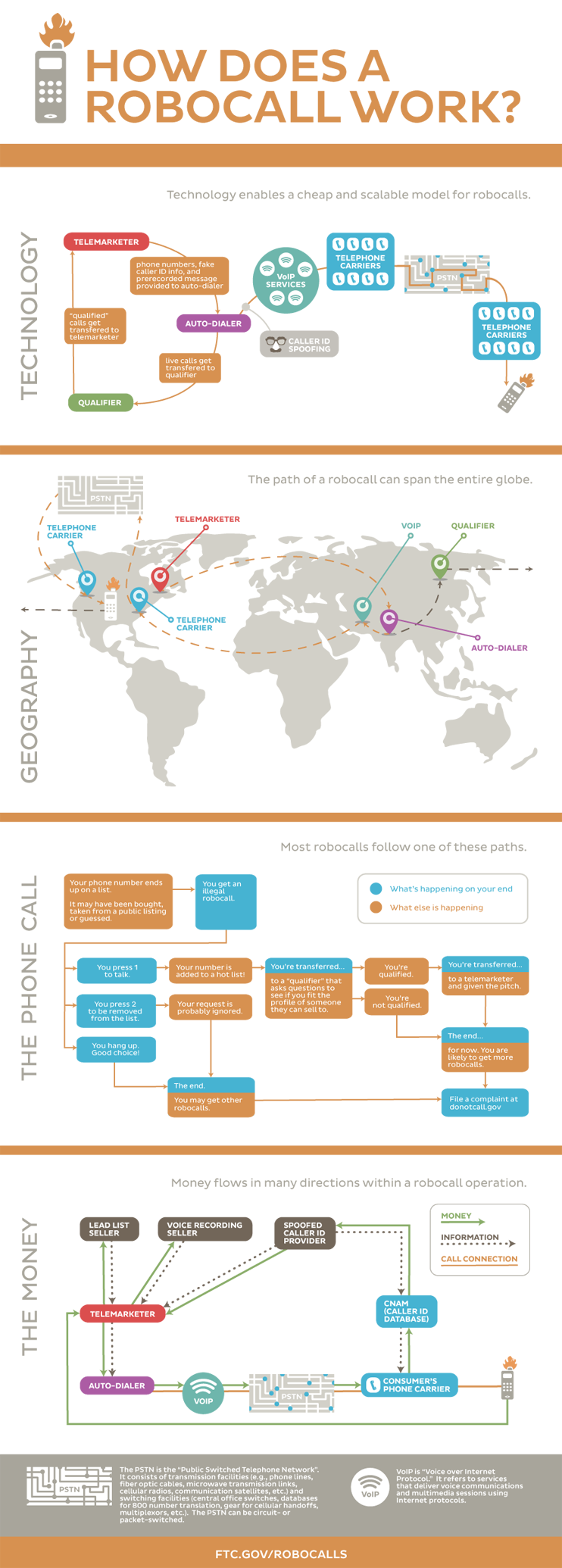
What is a Robocall?

If you answer the phone and hear a recorded message instead of a live person, it’s a robocall.  Americans have seen a significant increase in the number of illegal robocalls because internet-powered phone systems have made it cheap and easy for scammers to make illegal calls from anywhere in the world, and to hide from law enforcement by displaying fake caller ID information.

To date, the Federal Trade Commission (FTC ) has brought more than a hundred lawsuits against more than 600 companies and individuals responsible for billions of illegal robocalls and other Do Not Call violations.

The FTC also is leading several initiatives to develop technology-based solutions. Those initiatives include a series of robocall contests that challenge tech gurus to design tools that block robocalls and help investigators track down and stop robocallers. The FTC also is encouraging industry efforts to combat caller ID spoofing. Here’s the FTC’s game plan to combat robocalls:

  • continue aggressive law enforcement
  • build better tools for investigating robocalls 
  • coordinate with law enforcement, industry, and other stakeholders
  • stimulate and pursue technological solutions.

For More Information, click here.

Teaching Suggestions

  • Ask students how they or their families respond to robocalls.  Has the number of robocalls increased in recent months?  If so, what might be the reasons?
  • Ask students to make a list of actions to take in combating robocalls.  Share the list with other students.

Discussion Questions

  1. Should you consider reducing unwanted sales calls by submitting your phone numbers to the National Do Not Call Registry?
  2. Why doesn’t the National Do Not Call Registry stop robocalls?
  3. Are robocalls legal?  What kinds of robocalls are allowed without your permission?
  4. How can you manage to get fewer robocalls?

SCAM TRACKING MAP

Not everyone will be a victim of fraud, but everyone is a target. The AARP Fraud Watch Network offers a scam-tracking map to report fraud activity based on user-submitted information.

To help protect yourself and others, people are asked to report a scam they encounter.  The online form requests your zip code, method of contact (advertisement, door-to-door, Internet, e-mail, U.S. mail, or other), the type of scam, and the amount of money lost to the con artist. The list of scams includes more than 50 types, ranging from debt collection and charities to contests and online auctions.

Further assistance in reporting a scam is available at 1-877-908-3360.  AARP warns that it does not independently verify scam reports, nor guarantee the accuracy of reported scams.

Commonly suggested actions to avoid being taken by a scam include:

  • Only do business with reputable companies.
  • Understand contracts or other documents you sign.
  • Beware of impulse buying; con artists often tell you this is your last chance.
  • If it sounds too good to be true…it probably is!
  • STOP…WAIT…THINK…DON’T!

For additional information on the scam tracking map, click here.

Teaching Suggestions

  • Have students locate examples of current scams that have surfaced in their area.
  • Have students create a video with suggested actions to take to avoid being taken by a scam.

Discussion Questions 

  1. What are reasons that some people are easily deceived by frauds and scams?
  2. Describe actions that might be taken to avoid scams and fraud.

Gift Cards Scams

new data analysis by the Federal Trade Commission (FTC) shows that gift cards continue to be the most common form of payment when Americans report losing money to most scammers.

Since 2018, the data analysis shows American consumers have reported spending nearly $245 million on gift cards that they used to pay scammers for a wide variety of scams.   Scammers most likely to rely on gift cards as a payment method  were government imposters, family imposters, business imposters, and tech support scams.

In these scams, the scammers convince consumers that they must pay using gift cards. The reasons scammers present vary, but they always tell you that you must go to a retail outlet, purchase physical gift cards, and then provide the PIN numbers on the cards to the scammer. Reports suggest scammers favor certain brands of gift cards, such as, eBay or Amazon, however, their brand preferences change over time.

Because of the rapid increase in scams, the FTC has started a new campaign to partner with retailers around the country to help prevent consumers avoid a gift card payment scam.

The FTC has created warning signs that retailers can place directly at the point of sale for gift cards—both on the racks where they are displayed and at cash registers. The signs are designed to stop consumers who may be ready to buy gift cards to pay a scammer, raising key questions and reminding them that “gift cards are for gifts, not payments.

For more information, click here.

Teaching Suggestions

  • How many students have purchased gift cards and how did they use these cards? For personal use?  For gifts? For scammers?
  • What can you do to protect yourself and your family against gift card scams?
  • What will you do if someone calls you from tech support and asks you to pay them with a gift card to fix your computer?

Discussion Questions

  1. Why gift cards continue to be the most common form of payment for most scammers?
  2. Why do so many Americans get scammed by imposters?
  3. What can consumers do to avoid such scams?
  4. Discuss the statement, “Gift cards are for gifts, not payments”.